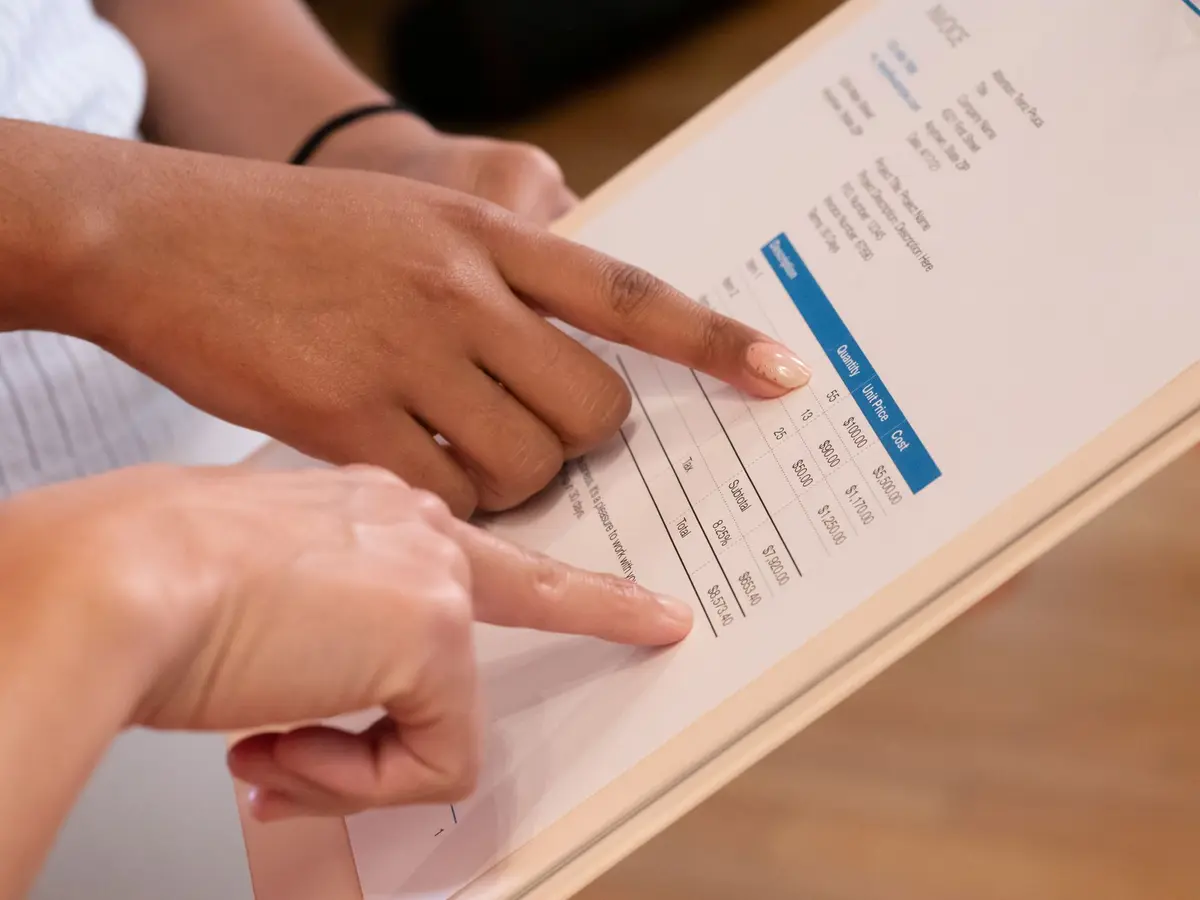
AI accounts payable clerk: invoice processing made automatic

An AI accounts payable clerk automates the high-volume, routine work: receipt of invoices from email and portals, extraction of line items and tax, matching against purchase orders and receipts, GL coding, approval routing, and reconciliation. Your person no longer spends days on data entry, chasing approvals, or hunting discrepancies. Instead, they review exceptions that the AI flags, negotiate with vendors, and manage relationships. For most businesses, the transition takes 3–6 weeks to live production, with the existing clerk staying in place during the switch.
In short
- Invoice receipt, data entry, matching, coding, and approval routing run automatically; your clerk handles exceptions and vendor relationships instead.
- Implementation takes 3–6 weeks with shadow mode first; the existing person stays in place and moves from data entry to exception resolution.
- Not all businesses benefit: low volume (
- Manufacturing, retail, and logistics see the biggest time savings because they process high volumes with standardized workflows.
- Real exceptions (mismatches, fraud, new vendors) still need human judgment; automation is most effective where exceptions are 15–30% of invoices.
What an accounts payable clerk actually does all day: the 6–10 recurring tasks
Most days, an accounts payable clerk works through this cycle:
- Invoice receipt and triage: Collect invoices from email inboxes, vendor portals, mail, and dropboxes; organize them for processing.
- Manual data entry: Type invoice number, vendor name, amount, date, line items and tax details into the accounting system or ERP (QuickBooks, NetSuite, SAP, etc.).
- PO matching and verification: Compare the invoice to the purchase order to check that quantity, price, and delivery match; note any discrepancies.
- Receipt matching: Confirm that goods or services were actually received before approving payment (the three-way match).
- GL coding and cost allocation: Assign the invoice to the correct general ledger account and cost center, project, or department.
- Approval routing: Send invoices to the right manager, department head, or executive for sign-off, often chasing them for timely approval.
- Payment processing: Schedule or execute vendor payments once approved, using bank transfer, check, or card.
- Vendor reconciliation: Compare vendor statements to your ledger each month to catch discrepancies, duplicate invoices, or overpayments.
- Exception handling: Investigate and resolve mismatches—missing POs, quantity variances, price changes, partial shipments, duplicate invoices, fraud flags.
- Reporting and compliance: Prepare aging reports, tax filings, audit documentation, and compliance records.
In high-volume environments (manufacturing, retail, logistics), a clerk processes 50–500+ invoices per month, much of which is repetitive keystroke and verification work.
Which of those tasks an AI worker takes over, task by task, and what it needs
An AI accounts payable worker handles the routine parts of this workflow automatically, cutting human touchpoints from 8–10 per invoice down to 1 or 2. Here is what runs without a person:
- Invoice receipt and extraction: The AI worker monitors your email inbox, vendor portals, and shared drives. It captures invoices as PDFs and images, then uses optical character recognition (OCR) and machine learning to read invoice data: vendor, number, date, amount, line items, tax, delivery address, and payment terms. It works with QuickBooks, NetSuite, SAP, Xero, ADP, and other ERPs you already use.
- Data entry into your ERP: The AI worker keys invoice details directly into your accounting system. No separate platform, no copy-paste, no manual re-entry. It writes to the same ledger your person uses.
- PO and receipt matching: The AI compares the invoice automatically to your purchase orders and goods receipt records. It flags real mismatches (wrong quantity, price variance beyond your tolerance, missing PO) and lets routine ones pass through. You set the matching rules—for example, a 2% price variance might auto-approve, but a 10% variance queues for human review.
- GL coding and cost allocation: The AI learns your coding patterns from past invoices and applies the correct general ledger account, cost center, and project code automatically. The first 50–100 invoices you review teach it your business logic; after that, it codes most new invoices without intervention.
- Approval routing: Based on rules you set (amount, vendor, department, cost center), the AI routes invoices to the right approver automatically. A $5,000 invoice for IT infrastructure goes to the CTO; a $300 office supply order goes to the office manager. No chasing emails needed.
- Three-way and multi-way matching: The AI compares invoice, PO, and receipt in one step. Partial deliveries, quantity splits, and freight additions are handled by the system's logic without manual investigation.
- Payment scheduling and execution: Once approved, the AI schedules payment according to your terms and cash position. It can execute ACH transfers, check runs, or card transactions directly, with audit trails locked in.
- Exception detection and flagging: The AI spots duplicates, mismatches, missing data, and fraud signals (unusual amounts, new vendors, unusual payment terms) and routes them to your person immediately, with context.
- Vendor reconciliation: The AI matches vendor statements to your ledger automatically each month, surfacing open items, underpayments, and overpayments for your person to resolve.
What the AI worker needs to do this:
- Access to your email inbox (read-only) or a shared email account for invoices
- Vendor portal logins (if you use Coupa, Ariba, or a supplier network)
- A live connection to your ERP system (API, SFTP, or direct database link)
- Your purchase order data in a structured format (uploaded from your procurement system or pulled via API)
- Your goods receipt records (if using a warehouse system)
- Bank account and payment method details (encrypted and segmented)
- Your approval rules and thresholds (set once, used for all invoices)
What stays with a person, and why
A human accounts payable person is not replaced; their role changes. They now own:
- Exception resolution: When the AI flags a mismatch, missing document, fraud signal, or unusual pattern, your person investigates and decides. Is the discrepancy normal for this vendor? Is it a shipping delay or a quality issue? Should payment be held? A human judgment call. The AI gathers the facts; the person makes the call.
- Vendor relationships: Disputes, payment disputes, contract negotiations, early payment discounts, and vendor onboarding all need human judgment and negotiation. The AI can flag when a vendor is owed early-payment terms or when a bulk discount applies, but the conversation happens with a person.
- Cash flow and payment timing: Even with automated payment scheduling, the finance person watches overall cash position and may choose to defer or accelerate payment to optimize working capital. The AI alerts; the person decides.
- Compliance and sign-off: Accounts payable is an audit control point. A manager or CFO must review and approve exception handling, unusual amounts, and period-end cutoffs. The AI provides full audit trails and flags, but a responsible person signs off on the process.
- System tuning and rule updates: As your business changes—new vendors, new cost centers, policy changes—your person (or finance manager) adjusts the matching tolerances, approval thresholds, and GL mapping rules. The AI learns and applies them, but humans own the policy.
- Fraud prevention: The AI detects anomalies (unusual amounts, new suppliers, changed payment details), but a person with knowledge of your vendors and business decides whether to investigate or block a payment.
- Month-end and year-end close: Final reconciliation, accrual adjustments, tax adjustments, and sign-off on financial statements are human responsibilities, though the AI surfaces all the data needed.
How this role differs by business type
| Business Type | What the Accounts Payable Clerk Does There That Is Specific | What the AI Worker Handles There |
|---|---|---|
| Manufacturing (multi-site, high volume) | Processes 500+ invoices monthly from hundreds of suppliers; matches complex multi-line POs; allocates to projects and asset codes; handles freight, consumables, and capital equipment in parallel; manages site-level approval hierarchies; tracks volume-based rebates and price breaks. | Automatically extracts line-item detail from supplier invoices; matches all items to PO and receipt; routes by plant, project, and cost center; flags partial shipments and quantity splits without manual tally sheets; tracks cumulative invoices against contract for rebate eligibility; learns site-specific GL mapping. |
| Retail (inventory-driven, seasonal) | High-volume receipt of inventory invoices with short payment windows; processes seasonal bulk orders; manages allowances and deductions from suppliers; coordinates with merchandise managers on returns and chargebacks; reconciles discrepancies in shipped-vs-billed quantities. | Captures inventory invoices at scale; matches to PO and receipt in real time; flags quantity variances (short-ships, overages); applies promotional allowances and discount terms automatically; routes approval by location and buyer; handles seasonal volume spikes without adding headcount. |
| Professional Services (law, consulting, contractors) | Processes invoices for freelancers, contractors, and service providers with variable line items and rates; verifies hours and billable rate against contracts and timesheets; handles retainers and draws; manages tax classification (1099 vs W-2). | Extracts service descriptions and hours from invoices; matches to contracts and timesheets (if provided); validates hourly rates and totals; flags mismatched hours or rates; routes to project manager or engagement partner for approval; captures vendor tax ID and classification automatically. |
| Healthcare (suppliers, pharma, services) | Processes invoices with compliance requirements (HIPAA, audits); manages rebates from pharmaceutical and device suppliers; reconciles patient-specific charges with billing records; handles revenue-related payables; manages government contracts and billing codes. | Automatically extracts and validates vendor credentials and tax IDs; flags non-compliant invoices (missing codes, invalid suppliers); applies rebate rules and accruals automatically; routes to compliance and billing verification roles; maintains full audit trail for regulatory review; supports multi-entity billing codes. |
| Logistics & Transportation (fuel, maintenance, multi-location) | Processes invoices for fuel, equipment maintenance, repairs, and services across multiple locations and vehicles; handles variable costs (fuel prices, repair parts); manages driver reimbursements and tolls; coordinates with fleet managers on maintenance schedules. | Automatically extracts fuel and mileage costs from supplier invoices; matches maintenance invoices to work orders and vehicle IDs; allocates costs to vehicle, route, or cost center; flags duplicate or missing charges; routes to fleet manager or location supervisor; learns seasonal patterns (winter maintenance, peak fuel periods). |
| Non-profit / Government Contracting (compliance-heavy) | Processes invoices under government contracts with strict compliance rules; allocates to cost categories (indirect, labor, equipment); manages spending caps and budget codes; maintains documentation for audits; handles pre-approval by program officers. | Automatically codes invoices to correct cost categories and budget codes; flags spending that exceeds thresholds or violates contract restrictions; routes to grant manager and compliance for pre-payment review; maintains immutable audit logs and evidence attachment; generates compliance reports automatically. |
How the switch happens: week by week, with the person still in place at first
The transition from manual to automated AP is not a cutover. Your clerk stays in place throughout, moving from data entry to exception handling. Here is a realistic 4–6 week rollout:
Week 1: Setup and Configuration
Your IT and finance team grant the AI system read access to your email, ERP, and procurement systems. You define:
- Approval workflows and thresholds (who approves what amount, from which vendor or cost center)
- GL mapping rules (which expense codes apply to which vendors or invoice types)
- Matching tolerances (how much price or quantity variance triggers a flag)
- Payment rules (which vendors get 2/10 terms, which are net 30, which net 60)
Your AP clerk reviews and validates these settings. No invoices are processed yet; they continue normal work.
Weeks 2–3: Pilot Phase (Shadow Mode)
The AI system begins processing invoices in shadow mode: it reads invoices, extracts data, codes them, and routes them, but does not post to your ERP or schedule payments. Your clerk reviews every invoice the AI processed, comparing its coding and routing to what they would have done.
- Accuracy typically reaches 90–95% by the end of week 2; your clerk notes where the AI misunderstood (unusual vendor names, non-standard formats, edge cases).
- You adjust GL mapping rules, tolerance thresholds, and approval routing based on real invoices.
- The AI learns from corrections: after 50–100 reviewed invoices, it adapts to your patterns.
- Your clerk works 20–30% less on data entry during this phase, spending more time on exception review and training.
Week 4: Limited Live Mode
The AI begins posting routine invoices directly to your ERP and scheduling payments for those with highest confidence (e.g., invoices that matched perfectly, from regular vendors, at expected amounts).
- Your clerk reviews the AI's work daily and approves before payment execution.
- Exceptions and flagged invoices (mismatches, new vendors, unusual amounts) still route to your clerk first.
- Payment volume sent to the bank is limited to say 60–70% of daily invoices; the rest are reviewed and approved by your person before posting.
- Your clerk spends 40–50% of their time on exceptions and validation, 50–60% on exception handling and vendor issues.
Week 5: Gradual Expansion
As accuracy and confidence metrics improve, the AI's autonomy expands.
- Routine, low-risk invoices post automatically without clerk review (e.g., known vendors, matched amounts, standard cost centers).
- Exceptions and new vendors still queue for your clerk.
- Payment execution moves to automatic for pre-approved invoices; your clerk monitors and audits the logs.
- Your clerk now spends 60–70% of time on exceptions, vendor issues, compliance, and strategic tasks; only 30–40% on routine processing.
Week 6+: Steady State
The system runs on autopilot for routine work.
- 70–85% of invoices post and schedule payment automatically, with full audit trails.
- 15–30% are exceptions: new vendors, mismatches, fraud flags, unusual amounts, missing documents.
- Your clerk spends their time on: exception investigation and resolution, vendor relationship management, contract negotiations, cash flow optimization, compliance, and close-of-month tasks.
- Processing time per invoice drops from 10–15 minutes (manual) to 1–2 minutes (review only) for routine items, and 15–20 minutes for exceptions (instead of 30+ minutes of research and chasing today).
- Headcount does not reduce immediately; instead, your person is freed for higher-value work. Some teams will choose to reduce headcount later; others redeploy the person to accounts receivable, purchasing, or finance analysis.
Risks and when NOT to automate this role
AP automation is not right for every business. Be cautious if:
- Your invoices are highly unstructured: If most invoices arrive as handwritten notes, physical paper only, or in non-standard formats (faxes, images of printed documents without machine-readable text), OCR will struggle and manual intervention will still dominate. Automation works best when suppliers send PDF or structured data.
- You have very low invoice volume (under 50/month): The fixed cost of setup and system maintenance can outweigh the time savings. Manual processing by one person may be more cost-effective.
- Your ERP system is very old or heavily customized: Legacy systems (SAP from the 1990s, customized Microsoft Dynamics, or in-house-built financial software) may not have stable APIs or integration points. Integration delays and custom development can extend timelines from weeks to months.
- You have no standardized approval rules or cost allocation logic: If approval authority and GL coding are ad hoc or change frequently, the AI will have nothing consistent to learn. You will need to first document and standardize these processes (a 2–4 week project on its own).
- Vendor compliance and data security are extreme: Some industries (defense, pharmaceuticals, healthcare with HIPAA constraints) require vendor contracts, data residency, and certification that many AP platforms do not support. Verify compliance before committing.
- You do significant international or cross-border AP: Multi-currency invoicing, foreign tax codes, and regulatory differences (e-invoicing mandates in EU, GST in Australia, customs duties) add complexity. Standard AP platforms handle some of this, but not all. Check the vendor's coverage of your markets.
- You are mid-implementation of a major ERP change: If you are already upgrading from QuickBooks to NetSuite or moving from on-premise to cloud, adding AP automation at the same time creates three concurrent changes. Consider sequencing: finish the ERP move, then layer on AP automation 2–3 months later.
- Exception handling is very high (30%+ of invoices): If your business generates many exceptions—partial shipments, frequent price changes, disputes, or non-compliant vendors—automation will flag them but your person still has to resolve most of them. The time saving is smaller. Focus first on fixing the supplier or process root cause.
- You have insufficient internal resources for configuration and training: AP automation implementation requires 2–4 weeks of time from your finance manager and often IT. If your team is already stretched on month-end close, tax, or other projects, the implementation will slip.
- You lack the governance mindset for automation: Automation requires clear, documented rules (thresholds, approval workflows, coding logic). If your business culture is informal and judgment-driven ("we'll decide case by case"), the AI will make unpredictable decisions. You need to codify your rules first.
Real limitations to acknowledge:
- AI OCR can misread handwritten or unusual fonts, invoices in languages other than English, or images of poor quality. The best systems reach 95–98% accuracy, not 100%. Budget for 1–3% manual correction.
- Matching invoices to POs works well if your PO data is clean and your receipts are recorded promptly. If you have missing POs or delayed receipt recording, the AI will flag many false exceptions.
- Approval routing is only as good as your rules. If your rules don't cover a scenario, the invoice will get routed incorrectly or held indefinitely. You will need to refine rules weekly in the first month.
- If your AP team is already lean (one person handling 300+ invoices per month), automation will not create headcount savings; it will free them for other work. Only teams processing 1000+ invoices per month with 2+ people typically see direct cost reduction from layoffs.
- Integration with your ERP is critical and sometimes brittle. If your ERP system updates or changes an API, the sync can break. You need a support plan.
How AiStaffo would automate this
AiStaffo automates the accounts payable cycle end-to-end: we connect to your email inbox, your ERP (QuickBooks, NetSuite, SAP), and your purchase order system. The AI worker monitors for invoice arrival, extracts all line items and tax using OCR, matches invoices to POs and receipts using your tolerance rules, codes them to the correct GL account and cost center, routes to the right approver automatically, and schedules payment once approved. Your accounts payable clerk reviews exceptions and vendors instead of typing invoice numbers all day. Routine invoices post to your ledger without human touch; unusual ones queue for your person to investigate. Payment execution, month-end reconciliation, and audit trails run continuously with full visibility. The result: invoices flow from receipt to payment in days, not weeks, and your person is freed for vendor negotiations, cash flow optimization, and compliance work. Book a free automation audit to see which of your AP tasks can run on autopilot.
Questions people ask
Will the AI system replace my accounts payable clerk?
How long does it take to implement AP automation?
What invoice formats can the AI read?
What happens if my invoices don't match my purchase orders?
Does the AI work with my ERP system?
What if I process very few invoices per month?
Book a free automation audit
Thirty minutes. We look at one process you run every week and tell you exactly what an AI worker would take off your desk, and what it would not.