UK VAT invoice: what a full VAT invoice must show

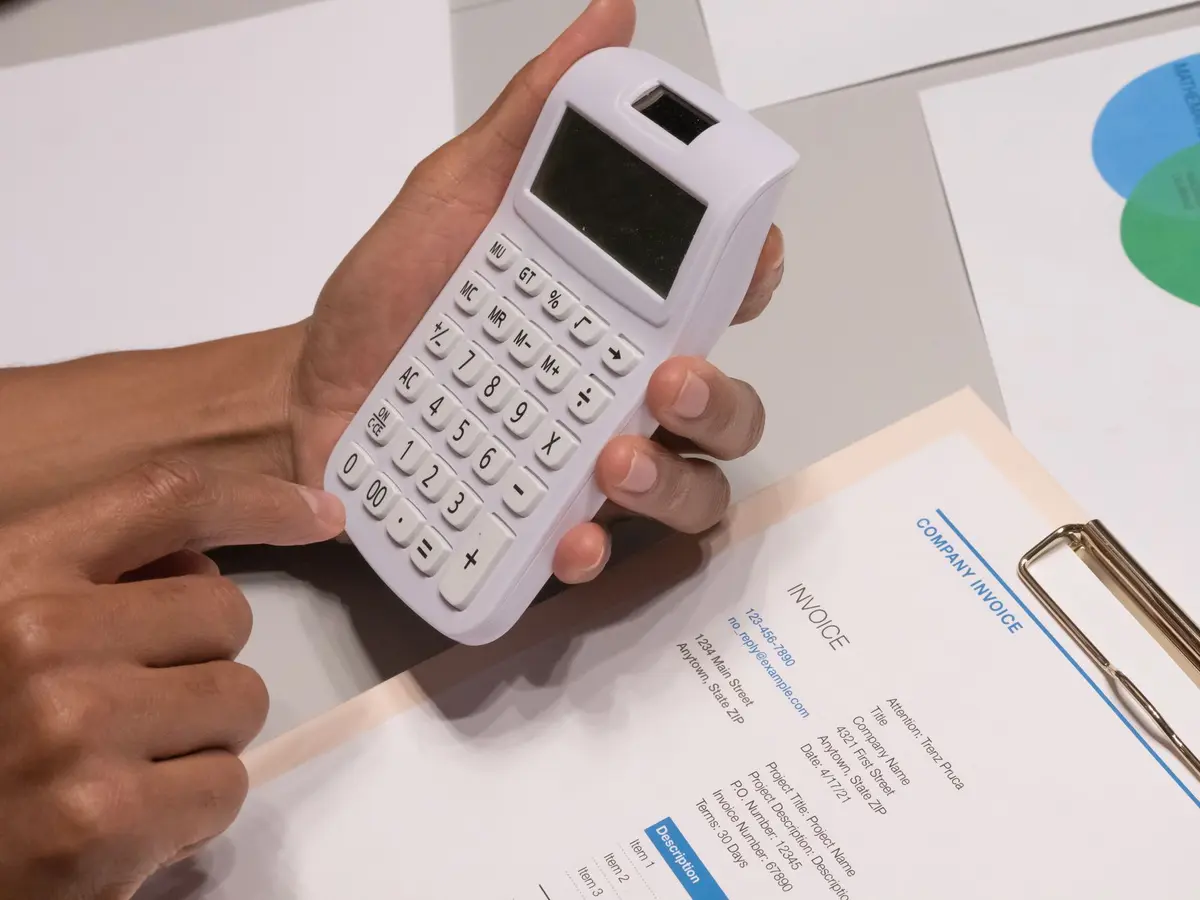
A full UK VAT invoice must show a sequential number, the time of supply (tax point), the date of issue if it differs, your name, address and VAT registration number, the customer's name and address, and a description of each item. For each item it must show the quantity and unit price excluding VAT, plus the VAT rate. The invoice must also show the total excluding VAT and the total VAT charged in pounds sterling. The core content comes from HMRC's VAT guide (Notice 700) and regulation 14 of the Value Added Tax Regulations 1995. For sales of £250 or less including VAT, a simplified invoice is allowed, and it can leave out the customer's details and the net amounts. Use the free calculator on this page to check each field before you send an invoice.
Work it out: VAT Invoice Generator (UK, 2026). Free, no sign-up.
In short
- A full UK VAT invoice needs a sequential number, the tax point, your VAT number, the customer's details, VAT rates and the VAT total in sterling.
- The simplified invoice applies to sales of £250 or less including VAT and can leave out the customer's details.
- A VAT invoice generally has to be issued within 30 days of the time of supply under regulation 13(5).
- Zero-rated and exempt items must be clearly marked, with separate totals.
- Checking the VAT rate for each product is a decision for your accountant or HMRC guidance, not the software.
What a full VAT invoice must show
HMRC's VAT guide, Notice 700, sets out the information a VAT invoice has to carry. Think of it as a checklist that an inspector will read line by line. If one field is missing, your customer may not be able to reclaim the VAT on it, so the list is worth enforcing in your invoicing tool rather than leaving to memory.
- A sequential number, built from one or more series, that uniquely identifies the document.
- The time of supply, also called the tax point.
- The date of issue, where it is different from the tax point.
- Your name, address and VAT registration number. You may trade under a different name, but the name and address you are registered under must appear somewhere on the document.
- The name and address of the customer you supplied.
- A description that identifies the goods or services, with the quantity or extent of each item.
- The unit price of each item excluding VAT, and the VAT rate that applies to it.
- The total amount payable excluding VAT, and the rate of any cash discount you offer.
- The total VAT charged, expressed in pounds sterling.
Two points on that list cause the most trouble. The first is the tax point. It is the date the supply is treated as taking place, and it decides which VAT return the sale goes on. The second is the sterling total. You can price a sale in euros or dollars, but the VAT amount that is due in the UK has to appear in pounds.
How the VAT figure is worked out, step by step
Start with the net price of each line, meaning the price before VAT. Multiply that net figure by the VAT rate for the line. At the standard rate of 20 per cent, a net price of £800 gives VAT of £160. Add the VAT from every line to get the total VAT, then add the total VAT to the total net price to get the gross amount payable.
Sometimes you only have a gross figure, for example a till total or a price that already includes VAT. HMRC's notice explains the VAT fraction for that case. At the standard rate, the VAT is one sixth of the gross price. So a gross price of £144 contains £24 of VAT and leaves £120 net. Work the fraction out for the rate that applied on the date of supply, not the rate you would use today if it has changed.
Worked example: a consultancy invoice at 20 per cent
A VAT-registered consultancy finishes a website audit and two training days for a VAT-registered client, and it also charges a set-up fee. The work is completed on 28 September 2026. The consultancy issues invoice number INV-2026-0042 on 3 October 2026. Both dates go on the invoice, because they are different.
| Item | Quantity | Unit price (ex VAT) | Net amount | VAT rate | VAT |
|---|---|---|---|---|---|
| Website audit | 1 | £800.00 | £800.00 | 20% | £160.00 |
| Training day | 2 | £150.00 | £300.00 | 20% | £60.00 |
| Set-up fee | 1 | £50.00 | £50.00 | 20% | £10.00 |
| Totals | £1,150.00 | 20% | £230.00 | ||
The total payable is £1,380.00, made up of £1,150.00 net and £230.00 VAT. The invoice must carry the customer's name and address, the description of each line, and the sterling VAT total. The regulations also require the invoice to be provided within 30 days of the time of supply. For this sale, that means no later than 28 October 2026. The consultancy issued on 3 October, so it was on time.
Cases that change the answer
The simplified invoice is the main exception. HMRC's guide allows a simplified invoice where the sale is £250 or less including VAT. It needs your name, address and VAT registration number, the time of supply, a description of the goods or services, and, for each VAT rate, the total payable including VAT and the rate charged. It does not need the customer's name and address or a net breakdown. If a customer asks for a full invoice, give one, because the simplified version is shorter by design.
Zero-rated and exempt items stay on the invoice, but they must be clearly marked as carrying no VAT. You also need a separate total for those items. If you would rather keep them apart, you can issue a separate invoice for them, which many businesses do to keep records simpler.
Where you use the reverse charge or the margin scheme, the invoice needs extra wording. Notice 700 covers that wording, so check it against the scheme you are using before you rely on a template. Invoices in a foreign currency are also allowed, provided the VAT total is shown in sterling.
The 30-day rule has limits too. The regulations allow a longer period where HMRC has allowed one, and HMRC's guidance on tax points explains how the date of physical issue sets the tax point when an invoice goes out late. Whether a longer period applies to your business is a question for your accountant.
Common mistakes
The most common error is a full invoice that shows the gross total only. The net amount, the VAT rate for each line and the VAT total all need to be visible, so a single total does not meet the rule.
The second mistake is a missing customer address. On a full invoice the customer's name and address are required. Templates often include a field for the buyer's name and leave out the address, which is easy to miss.
The third is number gaps. A sequence with unexplained jumps looks like missing invoices to anyone who reviews the books. If you void an invoice, keep a note of why and keep the number in the record.
The fourth is dates. Issuing an invoice weeks after the work is done, and then using the issue date as the tax point, can put the sale in the wrong VAT period. Where the tax point and the issue date differ, show both.
What to check with your accountant or HMRC
Confirm the VAT rate for each product or service you sell. The software can apply a rate you have set, but it cannot decide whether a product is standard-rated, reduced-rated, zero-rated or exempt. That decision depends on what you sell and, in some cases, to whom, so it belongs with your accountant or HMRC's guidance.
Ask your accountant whether a simplified invoice is right for a particular sale, and whether any extension to the 30-day period applies to you. Check the wording for reverse charge or margin scheme invoices before you use a template.
Finally, ask how long you must keep invoices and VAT records, and in what format, since digital record rules have changed in recent years.
AI workers can take the repetitive part of invoicing off your staff. They can assign the next number in the series, copy the customer's legal name and address from your records, apply the VAT rate you have set for each product, and check that every required field is filled before the invoice is saved. A person still confirms the rates, the tax point, and any unusual sale before the invoice goes out, and the same checklist works for the HR and payroll paperwork that follows routine billing.
This explains the rule in general terms; it is not legal or tax advice for your case.
Sources
How AiStaffo would automate this
AiStaffo would connect the invoice tool to the job or order records your team already keeps, and to the ledger your accountant uses. The AI worker would take the next number in your series, copy the customer's legal name and address, and apply the VAT rate you have set for each product. It would then run the field checklist from this guide and hold back any invoice that is missing a required field. You or your accountant still confirm each product's rate, the tax point and any unusual sale before the invoice goes out. Book a free automation audit.
Questions people ask
What must a VAT invoice include in the UK?
When can I use a simplified VAT invoice?
How long do I have to issue a VAT invoice?
Do zero-rated items need to appear on a VAT invoice?
Can I invoice in euros or dollars?
Book a free automation audit
Thirty minutes. We look at one process you run every week and tell you exactly what an AI worker would take off your desk, and what it would not.